
Why 8 Mil Diamond-Textured Gloves Are Becoming the New Workshop Standard
2026-10-12 16:21:34
Starting from a Workshop Visit
Why are auto repair procurement managers switching from thin gloves to 8 Mil diamond-textured gloves?
Not because gloves got more expensive — but because thin gloves carry too many hidden costs on the shop floor.
I’ve been in the glove supply business for twelve years, and I visit client workshops every year. Last year, I visited a European auto repair chain client, and their procurement manager showed me two sets of data:
The first set was their consumption record for thin gloves over the past six months — an average of 5 to 6 pairs per technician per shift. The second set was their record after switching to 8 Mil diamond-textured gloves — an average of 2 to 3 pairs per shift.
The unit price went up, but the monthly procurement total went down.
This is not an isolated case. Over the past two years, among the auto repair clients I work with, the procurement logic has been shifting: from “buying gloves by unit price” to “choosing gloves by cost-per-use.”
1. Two Failure Points of Thin Gloves in Auto Repair Shops
1.1 Failure Point 1: Losing Grip After Oil Contact
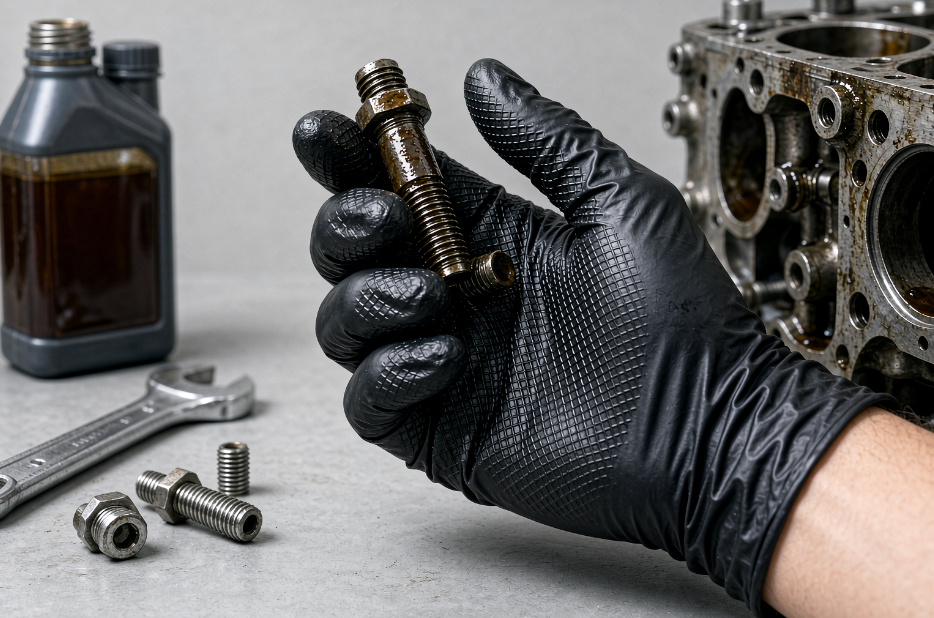
Auto repair workers aren’t dealing with water — they’re dealing with engine oil, brake fluid, transmission fluid, and grease. These liquids have far higher viscosity and lubricating properties than water. Once they contact the glove surface, friction drops sharply.、
Measured Data:
Test Condition | Smooth Thin Gloves | Diamond 8 Mil Gloves |
Dry | 100% (baseline) | ~115% |
After oil contact | ~40% (-60%) | ~85% (-15%) |
In real auto repair workshop conditions, diamond-textured gloves deliver more than double the grip of smooth gloves.
1.2 Failure Point 2: Tearing on Sharp Edges
Engine bays are filled with sharp metal edges, hose clamps, and rusty bolts. 3-4 Mil thin gloves tear easily on these components, forcing workers to stop frequently for replacements.
Industry Data: 8 Mil thick diamond-textured gloves deliver more than double the tensile strength of standard 4 Mil gloves, significantly reducing glove blowout rates during complex engine overhauls or heavy tool operations.
2. How Diamond Texture Solves the Slipping Problem
The Principle Is Not Complicated:
The raised diamond pattern creates micro-drainage channels on the glove surface. When the glove contacts an oily surface, liquid flows through the grooves between the pattern rather than remaining between the glove and the workpiece. The palm can thus maintain direct contact with the workpiece surface, preserving friction.
Workshop Validation: The auto repair clients I visited reported that after switching to diamond-textured gloves, technicians no longer frequently drop small washers and bolts when working on oil-covered engine parts. One workshop manager put it this way: “With smooth gloves, we used to drop more parts on the floor than we installed.”
3. The Bulk Procurement Math: Why 8 Mil Delivers Lower Total Cost
3.1 Cost-Per-Use Comparison
Comparison Dimension | Thin Gloves | 8 Mil Diamond Gloves |
Unit Price | Lower | Higher (~2x) |
Consumption Per Shift | 5-6 pairs | 2-3 pairs |
Cost Per Use | Baseline | ~35% lower |
Downtime for Changes | Frequent | Significantly reduced |
3.2 Additional Bulk Procurement Advantages
- Factory-direct pricing: Eliminates middlemen, locks in costs
- Lower per-unit shipping costs: Bulk orders dilute logistics costs
- Supply chain continuity: Avoids peak-season stockouts, ensures stable supply
- OEM customization: Supports brand packaging and glove logo customization
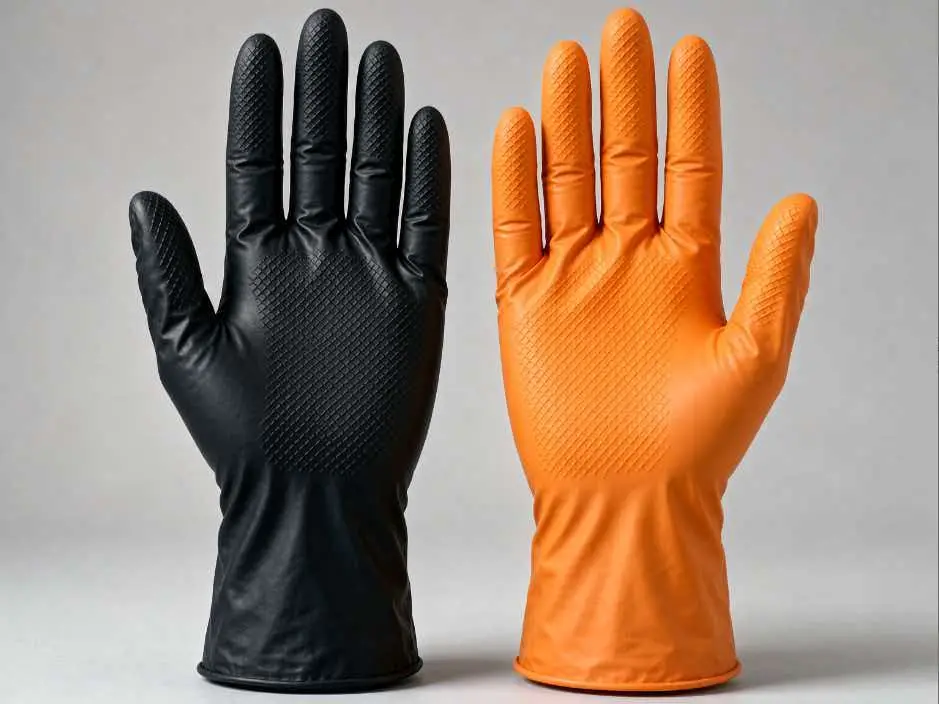
4. Black vs Orange: Color Selection Logic for Bulk Procurement
Comparison Dimension | Black Gloves | Orange Gloves |
Dirt Resistance | Excellent, hides oil | Moderate, oil visible |
High Visibility | Difficult to spot in dim areas | Excellent, highly visible |
Professional Appearance | Strong, customer-visible settings | Moderate, tool-like appearance |
Best For | High-end repair, customer-visible | General repair, safety-priority |
My Supply Experience: When supplying European clients, the ratio of black to orange is roughly 6:4. Black is mainly supplied to premium brand dealerships and customer-visible operations, while orange is mainly supplied to general repair shops and safety-priority workshops. This ratio varies by market, but both colors are standard stock for the auto repair industry.
5. Bulk Procurement Acceptance Checklist
As a supplier, I recommend buyers confirm the following before placing bulk orders:
-Thickness Confirmation: Are palm and fingertip thickness clearly specified?
-Texture Coverage: Does diamond texture cover full palm and fingers?
- Certifications: Are EN 374, EN 388, ASTM D6319 complete and valid?
- Batch Consistency: Are batch-specific COA reports provided?
- Packaging: Are 100 pcs/box and 10 boxes/case standard?
- MOQ and Lead Time: Do MOQ and lead time match procurement plans?
6. Conclusion
Bulk nitrile glove procurement in the auto repair industry is shifting from “looking at unit price” to “calculating total cost.” 8 Mil diamond-textured nitrile gloves solve both oily slipping and glove tearing through texture drainage and thick puncture resistance, reducing cost-per-use by approximately 35%.
As a supplier, our role isn’t just “shipping goods” — it’s helping buyers understand the application logic behind different glove specifications, so they can become more professional partners in front of their downstream customers.
BORAN is a China-based B2B disposable glove manufacturer, supplying 8 Mil diamond-textured nitrile gloves in black and orange, supporting bulk procurement and OEM packaging customization, with complete compliance documentation including EN 374, EN 388, and ASTM D6319, plus batch-specific COA reports. Global buyers are welcome to request samples or bulk quotes.