

How to Choose PVC, Nitrile, or Latex Gloves / B2B Sourcing Guide
2026-07-13 14:26:30
One Glove Does Not Fit All
Selecting the right disposable glove is more than a cost decision—it’s a matter of safety compliance, operational efficiency, and liability management. In B2B procurement, choosing PVC, nitrile, or latex often comes down to balancing three factors: protection level, user comfort, and total cost of ownership.
While Nitrile has emerged as the industry benchmark for versatility, Latex remains unmatched in elasticity for precision tasks,and PVC continues to dominate budget-sensitive, high-turnover environments.
This guide provides a technical breakdown to help procurement managers, safety officers, and distributors make data-driven sourcing decisions.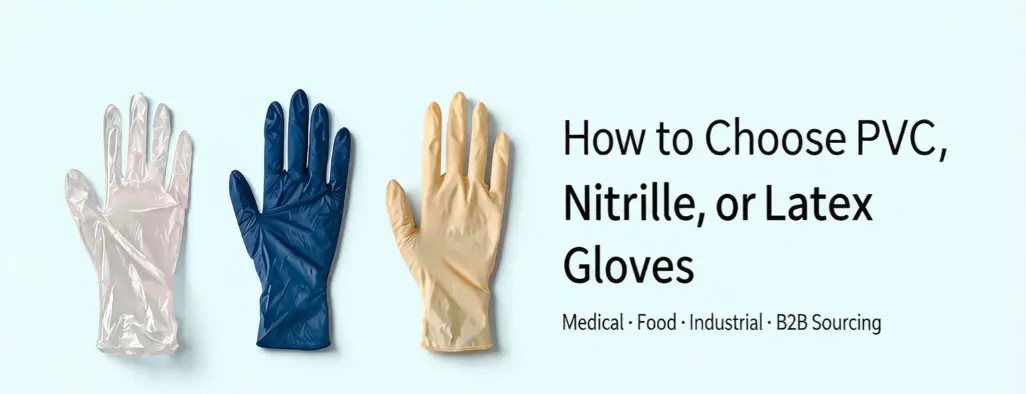
1. Technical Comparison: PVC vs. Nitrile vs. Latex
Understanding the polymer science behind these materials is critical for B2B buyers.
Below is a side-by-side comparison of key mechanical and chemical properties.
Feature | PVC Gloves | Nitrile Gloves | Latex Gloves |
Material Base | Polyvinyl Chloride + Plasticizers | Synthetic Nitrile Rubber (NBR) | Natural Rubber Latex |
Puncture Resistance | Low | High | Medium |
Tensile Strength | Low (~14-17 MPa) | High (≥18 MPa) | Very High (≥24 MPa) |
Elongationat Break | Low (<400%) | High (≥500%) | Excellent (≥750%) |
Elasticity & Fit | Loose, baggy fit | Snug, second-skin feel | Tight, highly elastic |
Chemical Resistance | Poor (Degrades with oils/fats) | Excellent | Fair (Not oil-resistant) |
Allergen Risk | None | None | ⚠️Allergy Risk |
Cost Level | $ (Lowest) | $$$ (Mid-High) | $$ (Mid) |
 Procurement Insight:
Nitrile offers the best Total Value due to its balance of durability and safety. While PVC has the lowest unit price, its higher replacement frequency and lower protection levels can increase indirect costs (injury claims, contamination).
2. Application-Specific Selection Guide
Scenario A: Medical & Clinical Environments
Recommendation: Nitrile (Standard) / Latex (Specialized)
Why Nitrile is the Gold Standard:
· Barrier Protection: Resists permeation from bloodborne pathogens and common disinfectants.
· Puncture Safety: Critical when handling hypodermic needles or surgical instruments (ASTM F1342).
· Allergy Mitigation: Eliminates the risk of Type I hypersensitivity reactions affecting up to 12% of healthcare workers.
When to Use Latex:
Ideal for high-dexterity procedures such as dental work or microsurgery where tactile sensitivity is paramount.
Note:Must be clearly labeled due to allergy risks.
Compliance Check:
Must meet ASTM D6319 (Nitrile) or ASTM D3578 (Latex) and hold FDA 510(k) or CE MDR certification.
Scenario B: Food Processing & Food Service
Recommendation: Nitrile (Preferred) /PVC (Budget)
Why Nitrile Wins for Food Safety:
· Oil & Fat Resistance: Unlike PVC or Latex, nitrile does not break down when handling greasy foods (e.g., fried chicken, burgers).
· No Migration Risk: High-quality nitrile eliminates concerns regarding plasticizer migration into food.
When to Use PVC:
Suitable for dry, low-risk tasks such as sandwich assembly or salad prep where frequent changes are required and budgets are tight.
Compliance Check:
Must comply with FDA 21 CFR 177.2600 (US) or EU Regulation 10/2011 (Europe).
Scenario C: Industrial & Manufacturing
Recommendation: Nitrile Only
Why Nitrile is Essential:
· Chemical Defense: Superior resistance against automotive oils, lubricants, and solvents.
· Mechanical Protection: High abrasion and puncture resistance (refer to EN388 ratings for specific cut levels).
· Durability: Longer breakthrough times compared to other disposables, reducing changeover frequency during long shifts.
Compliance Check:
Verify EN388 (Mechanical) or ASTM D6978 (Chemical Permeation) test reports based on specific chemical exposure.
Scenario D: Cleaning & Housekeeping
Recommendation: PVC
Rationale: For low-risk tasks involving mild detergents and water, PVC offers the most economical solution. Its loose fit allows for quick donning and doffing.
⚠️Warning: Switch to Nitrile immediately if handling aggressive solvents or acidic cleaners.
3. Quick Reference Selection Chart
Use this table as a cheat sheet for your procurement team:
Application | Recommended Material | Key Selection Factor | Key Standard |
Surgery | Nitrile | Sterility + Puncture Resistance | ASTM D6319 / EN455 |
Dental Work | Nitrile / Latex | Tactile Sensitivity | ASTM D6319 / EN455 |
Patient Examination | Nitrile | Allergy-Free Barrier | ASTM D6319 / EN455 |
Oily Food Handling | Nitrile | Oil Resistance | FDA 21 CFR 177 |
Dry Food Prep | PVC or Nitrile | Cost vs. Protection | FDA 21 CFR 177 |
Automotive Repair | Nitrile | Oil & Grease Proof | EN388 / ASTM D6978 |
Chemical Handling | Nitrile | Chemical Permeation | ASTM D6978 |
Janitorial Services | PVC | Low Unit Cost | — |
4. The B2B Procurement Decision Framework
Follow this 3-step process to ensure compliance and quality:
① Define the Hazard: Identify if the primary risk is biological (medical), chemical (industrial), or physical (food contamination).
② Verify Certifications:Never purchase without requesting valid test reports (MSDS, FDA, CE). Ensure the certificate matches the specific product SKU.
③ Conduct Field Testing: Request samples. Test for fit (fingertip dexterity) and durability (snag/puncture tests) in your actual working environment before signing bulk contracts.
✅B2B Buyer’s Checklist
[ 1] Identified specific use-case (Medical/Food/Industrial)?
[ 2] Verified required compliance standards (FDA/CE/EN)?
[3] Requested and reviewed factory audit reports?
[4] Conducted on-site sample testing?
[5] Confirmed batch-to-certification traceability?
[6] Negotiated long-term pricing or formula-based contracts?
5. Source Smart, Stay Safe
There is no universal "best" glove—only the right glove for the job. By prioritizing Nitrile for high-risk environments,Latex for high-precision needs, and PVC for cost-efficiency, you protect both your workforce and your bottom line.
At BORAN Medical, we manufacture a full portfolio of PVC, Nitrile, and Latex gloves designed to meet stringent global standards. Whether you require medical-grade barrier protection or food-safe disposables, our technical team is ready to support your sourcing strategy.
Ready to optimize your PPE supply chain?
Download Our Full Product Catalog /Request Compliant Samples /Get a Wholesale Quote
About BORAN Medical
BORAN Medical is a leading B2B manufacturer of disposable gloves based in China. We specialize in supplying hospitals, group purchasing organizations (GPOs), and industrial distributors worldwide.
Our Capabilities:
✅ Full Range: PVC, Nitrile (Powdered/Powder-Free), Latex.
✅ Certified Quality: FDA 510(k), CE MDR, ISO 13485, EN374/388.
✅ Custom Solutions: Private labeling, custom packaging, and dedicated production lines.
✅ Supply Stability: Robust production capacity ensuring consistent delivery schedules.
FAQ
Q: Are nitrile gloves better than latex for food handling?
A: Yes,nitrile gloves for food handling are better than latex . Nitrile is superior because it is food-safe, resistant to animal fats and vegetable oils, and contains no latex proteins, eliminating allergy risks for food handlers and consumers.
Q: Can I use PVC gloves for medical exams?
A: No. PVC gloves lack the necessary tensile strength and barrier protection required for medical examinations. They do not meet ASTM or EN medical standards.The Suitable gloves are nitrile examination gloves or latex examination gloves.
Q: What does AQL 1.5 mean for gloves?
A: AQL (Acceptable Quality Limit) 1.5 is the standard for medical-grade gloves, meaning statistically there will be no more than 1.5% defective gloves in a batch. It is a critical metric for safety compliance.